
Brick Roofing provides flat roof repair in Brick, NJ, serving surrounding cities including Point Pleasant, Leisure Village East, Brielle, Point Pleasant Beach and Leisure Village. In more than two decades of roofing at the shore, we have repaired low-slope roofs on porches, dormers, additions, garages, shore houses with roof decks and commercial buildings, and the first step is always the same: work out which membrane is on the roof.
Flat roofs are not one material. Modified bitumen, EPDM rubber, TPO and PVC each have their own seams, their own repair materials and their own way of failing. A patch made with the wrong product does not bond, and that is why so many flat roof repairs leak again within a season.
We also tell you plainly whether a repair makes sense. A single open seam or a punctured section is a repair. A membrane that has gone brittle across the whole roof, or soaked insulation under it, means patching will not hold for long, and we show you why with photographs from the roof and from inside.
Repairs by Roof Type
Modified Bitumen
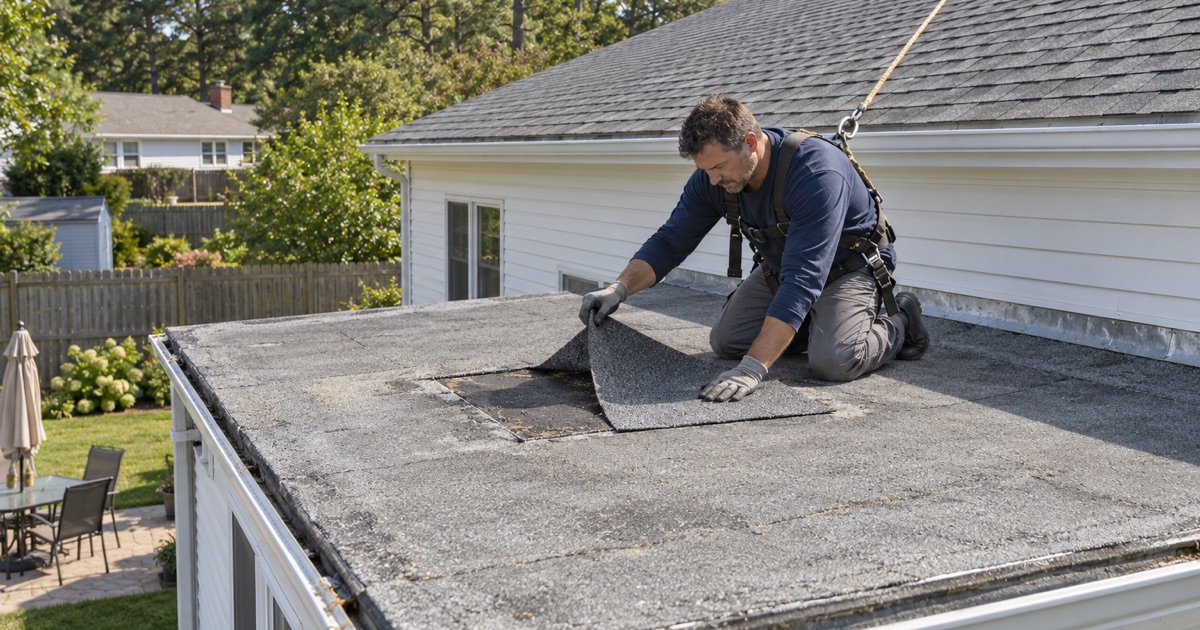
SBS and APP modified bitumen roofs are built from asphalt-based sheets, often torch-applied, with a granulated or smooth surface. Common problems are blisters, split seams, cracked flashing at walls and areas worn thin where people walk. We cut out damaged sections and install new material heat-welded or adhered into the surrounding sheet, overlapping well past the damage.
Blisters need care. A blister that is not leaking is often best left alone, but one that has split or sits where water collects needs to be opened, dried and patched. We judge each one individually rather than cutting into every bump on the roof.
EPDM Rubber
EPDM is a black rubber membrane with seams joined by tape or adhesive. Over time seams can open, especially at corners and laps, and the membrane can shrink and pull at the edges. We clean and prime the rubber and repair it with compatible EPDM seam tape and patches, because adhesives made for other membranes will not hold on rubber.
TPO and PVC Single-Ply
TPO and PVC are light-colored membranes with heat-welded seams. Repairs on them are also heat-welded, with new membrane fused to clean, prepared existing material. We check the surrounding seams with a probe as part of the repair, since a weak weld next to a puncture is often the next leak.
Older Built-Up Roofs
Some older buildings still have built-up roofs of tar and felt layers, sometimes covered in gravel. Small areas can be repaired, but these roofs are often at the end of their life by the time they leak regularly. We look at the condition of the whole roof before recommending how much repair is worthwhile.
Where Flat Roofs Leak
Wall Flashing and Porch Roofs
The most common leak point on a house is where a porch roof or addition meets the main wall. The membrane has to turn up the wall and be covered by counter flashing or siding. When that joint was finished with sealant alone, it opens over time. We rebuild the turn-up and counter flashing so the joint sheds water properly.
Drains, Scuppers and Edges
Flat roofs depend on drains, scuppers and gutters to move water off. When they clog with leaves or sand, water rises and finds every weak seam. We clear and repair drainage, check the membrane around each drain and fix lifted edge metal that lets wind under the roof.
On homes near the ocean and the bay, edge metal fasteners and flashing corrode quickly in salt air. We use corrosion-resistant fasteners and metal for edge repairs, so the edge holds against the wind instead of loosening again after a season.
Penetrations and Roof Decks
Vents, pipes, skylights and the posts of rooftop decks all pass through the membrane, and each needs its own flashing or boot. Deck posts in particular can work loose and tear the membrane around them. We reflash penetrations with materials matched to the roof and check that deck posts are secured and sealed.
Standing Water and Wet Insulation
Fixing Ponding Areas
Water that sits on a flat roof for days speeds up wear and makes small defects into leaks. We locate the low areas and discuss options such as adding a drain, building up the low spot or installing tapered insulation during a larger repair, so water drains toward the outlets.
Sometimes ponding is a sign of a structural problem rather than a roofing one. Sagging joists under an older porch roof or an addition can leave a permanent dip that collects water after every rain. We check the framing from below where we can, and if the structure needs attention, we say so before any roofing goes back on top of it.
Checking for Wet Insulation
Water that gets under a membrane can soak insulation over a wide area while only one small leak shows inside. Wet insulation loses its value and keeps the deck damp. We check areas around leaks for wet material and replace it during the repair rather than sealing water in under a new patch.
Repair or Replace
When a Repair Makes Sense
A flat roof with one or two clear problems, such as an open seam, a puncture or a failed wall flashing, on a membrane that is otherwise flexible and well attached is a strong candidate for repair. A properly made patch on a sound roof can add years of service, and we would rather quote that than a replacement you do not yet need.
When Replacement Is the Better Value
When the membrane is cracked or brittle across the roof, blistered in many places, or sitting on wet insulation, repairs become a cycle of chasing the next leak. At that point we price a replacement with the same line-item detail as any other job, so you can compare the cost against continued patching and decide with clear figures.
- 20+ Years in Roofing
- Attic and Roof Leak Checks
- Line-Item Written Scopes